Who Survives in the Age of AI?
In Part 1, I argued that Perplexity — despite building an excellent product — is doomed because it built a harness in exactly the space the major labs are racing to own. The routing layer, the orchestration, the multi-model magic: all of it lives in the crosshairs of companies with deeper pockets and captive user bases.
That raises an obvious question: if building harnesses for the labs' own models is a losing game, what actually survives?
The Labs Won't Become Everything Apps
Here's my first counterintuitive claim: I don't believe the major labs will become everything apps. They will be many-thing apps. They'll be capable of being everything apps to some users. But most of us don't have the time or imagination to use a single app for everything, because we don't know the problems we have or realize there could be a better way.
The common thread across every durable platform company is the same: they recognized problems others couldn't yet articulate and built solutions that reframed the question entirely. Users didn't ask for the iPhone, the search engine, or the cloud. Someone saw a gap before the market had language for it.
The AI labs are building incredible general-purpose tools. But general-purpose is a double-edged sword. The same flexibility that lets you do anything means the tool doesn't suggest anything. It waits for you to have the idea. And most people — busy, distracted, focused on the next meeting — don't have the idea.
The Inventor in Your Pocket (We're Not There Yet)
The main question is whether a single app can get to know people well enough to be an actual inventor in their pocket. Not an enabler of invention — an inventor. There's an enormous gap between those two things.
Today, AI tools are enablers. You bring the problem, the tool helps you solve it. You want to analyze data? Open Claude, describe what you need. You want to build an app? Fire up Cursor, start prompting. The human is the inventor; the AI is the accelerant.
Now imagine the reverse: an AI app that surfaces the problem you didn't know you had. Marketing helps people discover the solution to a problem they haven't articulated yet — that's the entire ad industry in one sentence. Could an AI do the same thing, but without the ad? Could it get to know you so well that it says, "Hey, based on how you work, here's something that would save you three hours a week," and then build the entire workflow, UI, and solution on the spot?
It's not impossible to imagine. But it creates a new problem: can the various functions of a single app be partitioned enough in people's minds? We're used to dedicated apps for dedicated problems. A notes app. A calendar. A task manager. A design tool. When one app tries to do everything, it often ends up feeling like it does nothing particularly well — not because of capability, but because of cognitive load. Users need to think of it at the right moment, and that's the hardest distribution problem in software.
What Actually Wins: Domain Expertise + Dedicated Solutions
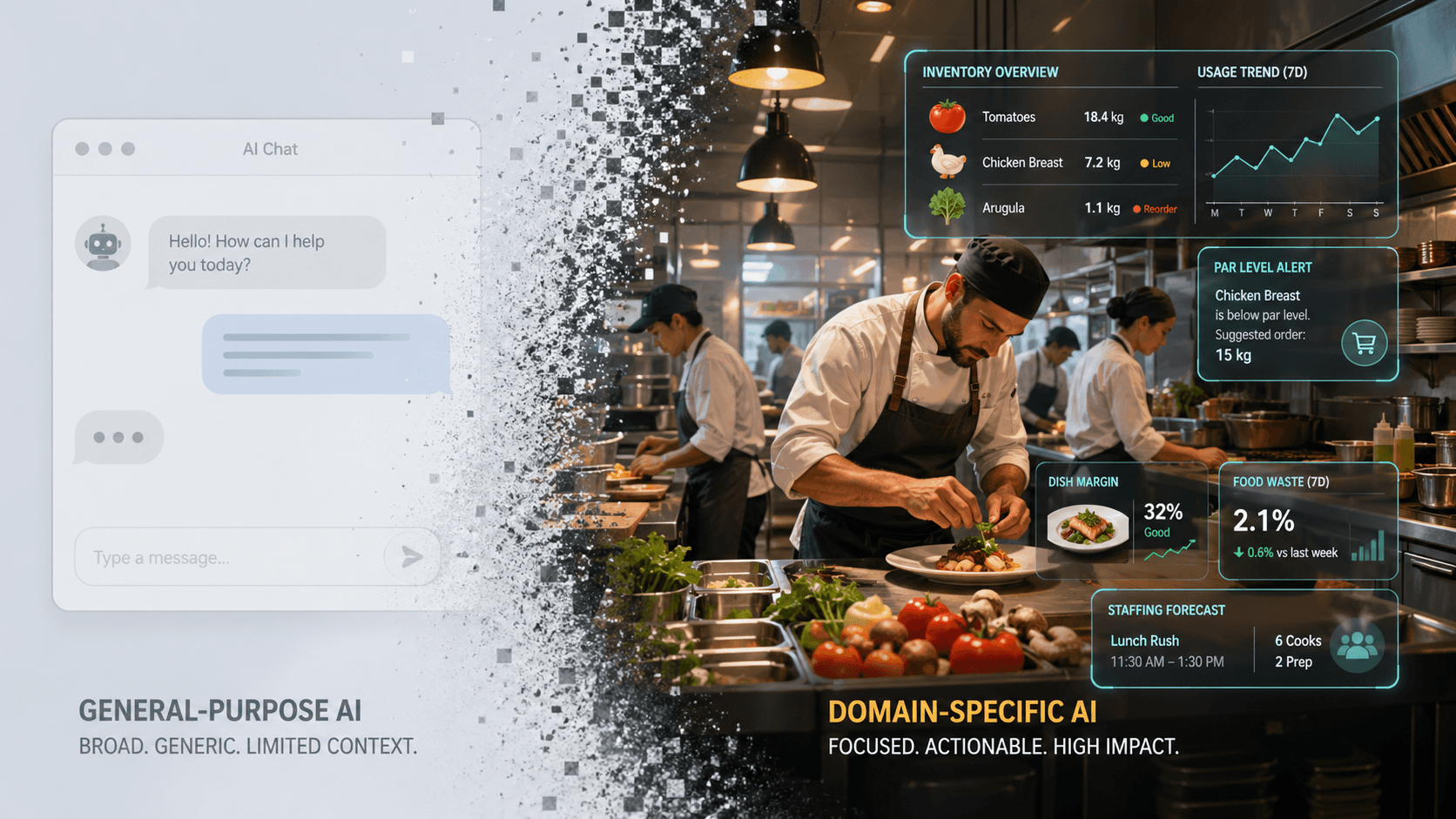
Here's where I land: the companies that survive are the ones building solutions to complex problems that require domain expertise, using AI as the engine but not as the product.
Picture this: an inventor sees a common problem in, say, restaurant supply chain management. They use AI to build a tool that handles inventory prediction, vendor communication, and waste reduction. They launch it with a dedicated UI, purpose-built workflows, and marketing that speaks directly to restaurant operators. The tool is powered by the same frontier models available to everyone, but the solution — the domain knowledge baked into the prompts, the workflow design, the edge cases handled — that's the moat.
This is fundamentally different from what Perplexity is doing. Perplexity built a better way to access the models. The restaurant supply chain tool built a better way to solve a specific problem using the models. One is a harness; the other is a solution. The harness is in the labs' crosshairs. The solution isn't, because the labs aren't going to hire restaurant supply chain experts to build vertical workflows for a niche market.
The Differentiation Test
If I had to give founders a single litmus test, it would be this: would your target customer think to do this in ChatGPT?
If the answer is yes — if a reasonably savvy user could open a general-purpose AI tool and accomplish roughly the same thing — you're building in the danger zone. You're competing with the labs' roadmap. You might have a head start, but you're running a race where the other runners have jet packs.
If the answer is no — if the problem is specialized enough, the workflow complex enough, or the domain knowledge deep enough that it wouldn't occur to someone to even try it in a chat interface — you're in safer territory. Not safe territory, because nothing in AI is truly safe. But safer.
Perplexity fails this test. "Search the web and give me a sourced answer" is exactly the kind of thing people now do in ChatGPT, Claude, and Gemini. "Route my query to the best model" is a feature the labs are building natively. The use case is too intuitive, too general, too obviously in-scope for the platforms.
The Brand Awareness Problem
There's a practical dimension too. Perplexity lacks brand awareness among average consumers. In tech circles, everyone knows it. In the broader market? ChatGPT is a household name. Google is Google. Claude is growing fast. Perplexity is a word most people can't spell.
This matters because the general-purpose AI space is a land grab for attention, and attention follows brands. If you're building a specialized tool for restaurant operators or insurance adjusters or music producers, you don't need mass-market brand awareness. You need to be known in your vertical. That's a solvable distribution problem. But if you're building a general-purpose harness that competes with ChatGPT for the same user's attention? You need the kind of brand recognition that takes billions of dollars and years to build.
It's Not All or Nothing
I want to be careful not to paint this as binary. The future isn't "everything app" vs. "niche tool." It's a spectrum. The labs will keep expanding what their platforms can do. Some of what they build will be mediocre — good enough to kill a startup but not good enough to delight a power user. Some of it will be exceptional. The question for any company building in the AI space is: where on that spectrum does your product live?
If you're building a harness that could be built by the labs, you're in their crosshairs. If you're building solutions to complex problems requiring domain expertise with their tools, you're in the safest space available. Perplexity, unfortunately, built in the former.
The irony is that Perplexity has the talent and the product instincts to build in the latter. They've proven they can ship fast, iterate well, and design beautiful experiences. If they pointed that energy at a vertical problem — something the labs would never prioritize — I'd be writing a very different post.
But as it stands, the best orchestration layer in the world is still just an orchestration layer. And when the orchestras start building their own conductors, the independent conductor has a problem.
This is Part 2 of a two-part series. Part 1: Perplexity Built an Amazing Product. It Won't Survive. covers why Perplexity's specific position is in trouble despite excellent execution.
Get AI strategy updates in your inbox.