The $2,500 Mac Mini Won't Save You From the Cloud
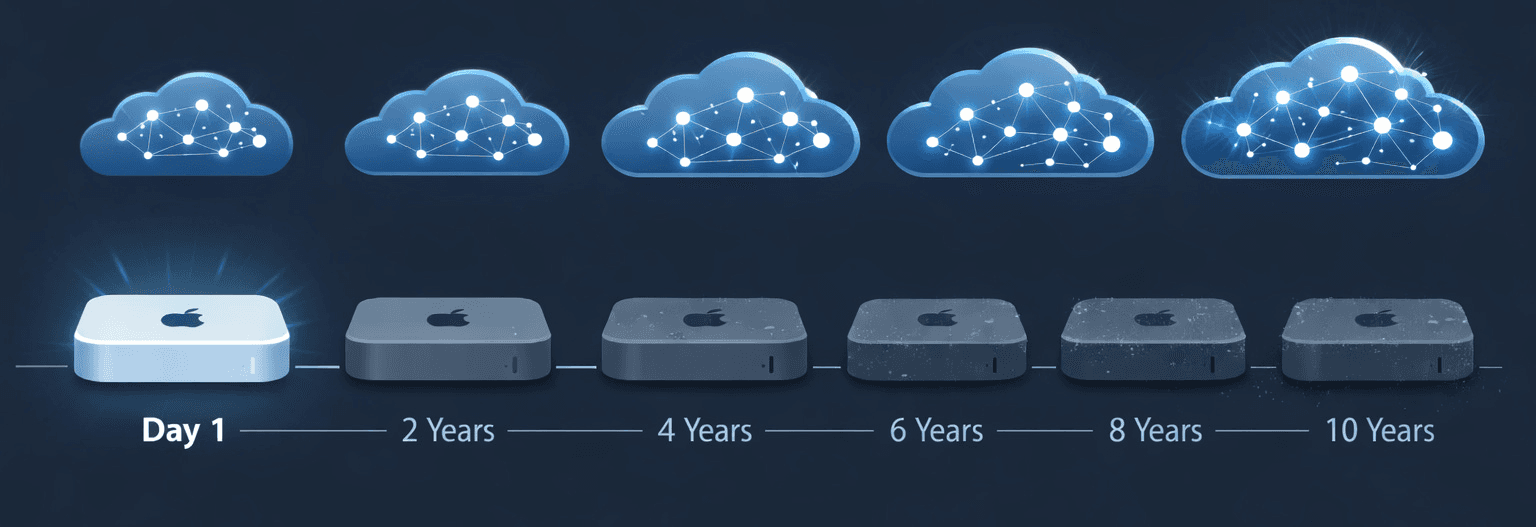
There's a recurring narrative in AI Twitter: buy a Mac Mini, install open-source models, run your own RAG pipeline, and never pay a subscription again. $2,500 once. Yours forever.
It sounds like freedom for those of us deep in AI workflows but is actually a bet against the pace of the industry you're trying to keep up with.
The Math Doesn't Hold
The argument goes like this: Perplexity charges $20–$200/month. Over ten years, that's $2,400–$24,000. A Mac Mini costs $2,500. Therefore, buy the hardware.
This frames AI subscriptions as a static cost against a static capability. Neither is true.
At $20/month, the break-even is ten years. Do you think a Mac Mini purchased today will be a competitive inference machine in 2036? The M-series chips are impressive right now. In two years, they'll be mid-tier. In five, they'll be legacy. Hardware depreciates. Cloud capabilities compound.
The comparison also ignores what you're actually buying with a subscription. Frontier labs spend billions on training runs, RLHF, tool use, multimodal reasoning, and safety infrastructure. A local Llama instance doesn't compete with Claude or GPT on the tasks where AI creates the most value: complex reasoning, large-context synthesis, agentic workflows. You're comparing a bicycle to a commercial airline and noting that the bicycle has lower operating costs.
The Ceiling Problem
I run local models and it's so cool trying a new local model. My MacBook Pro handles inference for specific tasks where latency matters, where I want privacy, or where I'm experimenting with something I don't want hitting an API. Local inference is a real tool in the stack.
But it has a low ceiling on day one, and that ceiling doesn't move.
A $2,500 machine has serious limitations and you'll quickly find a 7B model won't get you very far. The models you run on it today are the best models it will ever run well. Meanwhile, frontier models get better quarterly. The gap between local and cloud widens every release cycle.
This is the part the "own it forever" crowd underestimates. You don't own a capability forever. You own a depreciating asset that falls further behind a moving target.
What You're Actually Buying
When you subscribe to a frontier lab, you're not renting search results. You're buying continuous access to the current best-in-class reasoning engine, updated without you lifting a finger. The model improves. The context window grows. New capabilities ship. Your subscription price stays flat while the value increases.
When you buy hardware, you get the opposite curve. The value is highest on day one and declines from there. Every breakthrough in model architecture, every new training technique, every capability jump makes your local setup relatively worse.
And keep in mind, cloud providers have two other massive advantages:
- Hardware utilization: You're really paying to rent compute. A model spins up, runs your task, then takes on the next in queue. You'll never match that locally unless you're literally running 24/7.
- Competition: The big labs are all competing for tokens. It's been pointed out many times that you can get the equivalent of thousands of dollars in API usage from a $200 per month Claude sub. Unless inference costs come WAY down, it can't always be like this — take advantage while these conditions exist.
This isn't an argument against owning hardware. It's an argument against framing hardware as a replacement for cloud access.
The Real Play
The people doing serious work with AI aren't choosing local or cloud. They're running both.
Local inference for privacy-sensitive tasks, for offline capability, for experimentation, for fine-tuned domain models. Cloud subscriptions for frontier reasoning, for the tasks where capability matters more than cost.
If someone told you to cancel your cloud compute and run everything on a desktop tower because the upfront cost is cheaper, you'd recognize that as bad infrastructure advice. The same logic applies here.
The better hardware recommendation, if you want local capability, is a MacBook Air with 64GB of unified memory and a 1TB SSD. You get portability, basic local inference, and you're not locked to a desk pretending your Mac Mini is a data center. Pair it with a cloud subscription. Total cost: roughly the same as the Mac Mini pitch, but you get a machine you can actually carry and frontier-level AI when you need it.
Look, I recently swapped my M3 Air for an M5 Pro so I'm not saying this is the answer for everyone but it fits a profile of a cloud-first intelligence system in a mobile package. It comes with good GPU performance but put more into RAM and local storage to optimize for tools like running Claude Code and Cursor.
The Rental Economy Framing
The original post frames cloud subscriptions as a "rental economy" you can opt out of. That framing is seductive and wrong.
Every SaaS subscription is rent. Every API call is rent. Every managed database, every CDN, every CI/CD pipeline. The entire modern tech stack is a rental economy, because renting scales, updates automatically, and shifts maintenance to someone else. That's not a flaw. That's the value proposition.
The question isn't whether you're renting. The question is whether the rent buys you something you can't efficiently own. For frontier AI, the answer is clearly yes. The training costs, the research teams, the infrastructure. You can't replicate that on your desk. You can run a local model that handles 80% of simple tasks. But the 20% where frontier models shine is where the real advantage compounds.
Who This Advice Hurts
The "buy a Mac Mini and skip the subscription" pitch sounds empowering. But it's aimed at exactly the wrong audience: people who are cost-sensitive and trying to get started with AI.
Those people don't need to invest $2,500 in hardware that deprecates. They need a $20/month subscription that gives them access to the best tools available today, tomorrow, and next year. They need to build fluency with frontier models first, understand what AI can actually do for their workflow, and then decide whether local inference fills a gap.
Starting with local-only is like learning to drive in a go-kart and assuming you understand highway traffic.
The Bottom Line
Local inference is a legitimate tool. Open-source models are getting better fast. There are real use cases where running your own stack makes sense: privacy, latency, cost at scale, experimentation.
But framing a one-time hardware purchase as a path toward being subscription free is bad math dressed up as independence. The industry has been moving too fast for your hardware to keep up. Your $2,500 machine is a great tool today but already incapable of running the largest open source models.
Having a coherent AI strategy is as important for individuals as businesses. I just made a significant investment in my own hardware and am all for local builds. But real independence comes from keeping options open and having the right tool for each job.
What's your setup — are you running hybrid, or have you gone all-in on one side?
Get AI strategy updates in your inbox.