The Goalposts Keep Moving: From 'The Models Don't Work' to 'The Users Are the Problem'
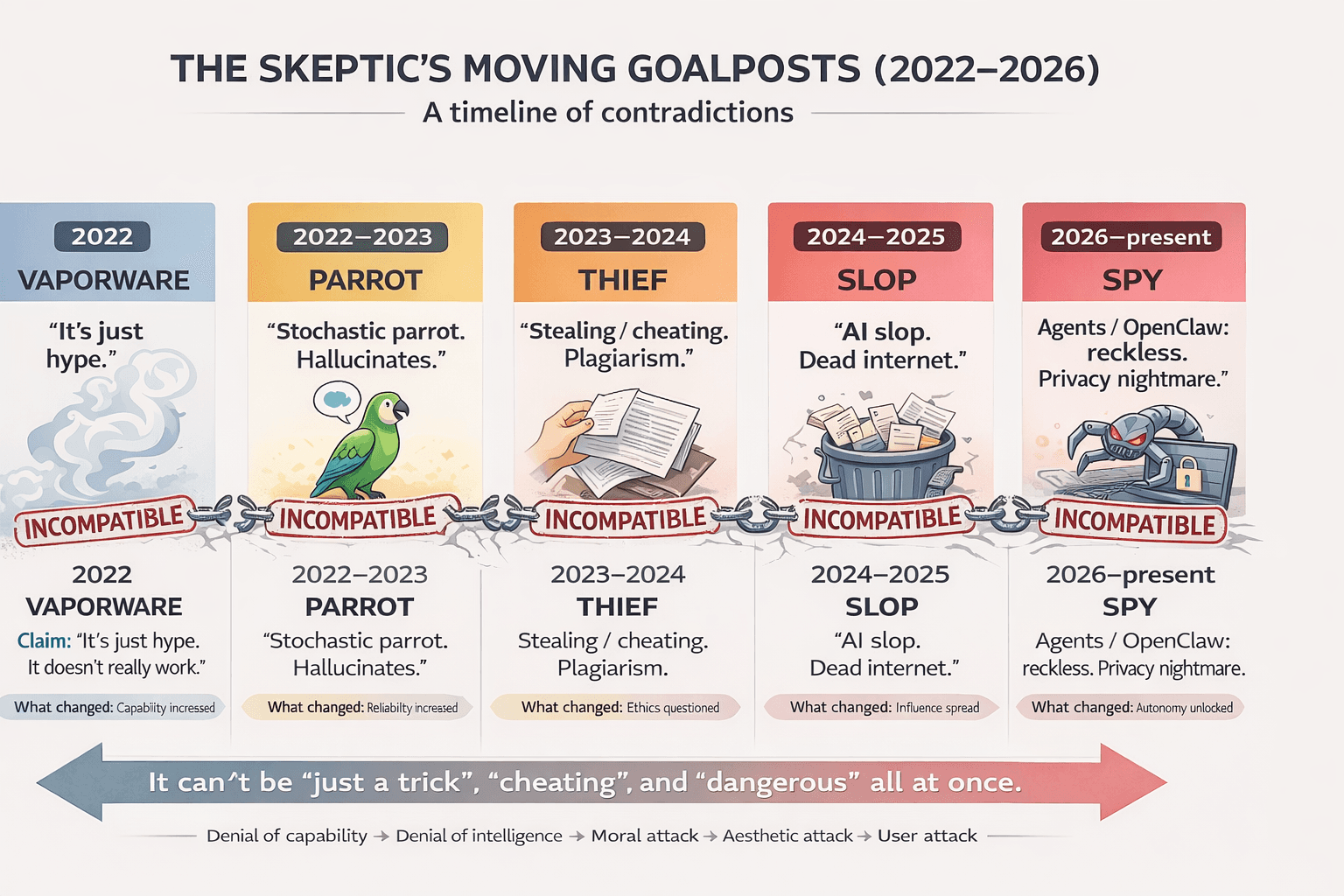
There's a pattern emerging in the AI discourse.
First, the models were toys. Then they were overhyped. Then they would plateau. Then they would hallucinate themselves into irrelevance. Then they would collapse under regulation or cost.
As each prediction aged poorly, the critique shifted.
Now the problem isn't the models.
It's the people using them.
The New Frame: AI as a Moral Shortcut
The latest iteration of skepticism isn't primarily technical. It's cultural and moral.
"If you use AI to write, you're cheating." "If you use AI to code, you don't really understand it." "If you use AI at work, you're cutting corners." "If you rely on it, you'll lose your cognitive edge."
Notice what happened. The critique moved from capability to character.
This is no longer an argument about whether the systems work. It's an argument about whether you should use them at all.
That's a significant shift.
When Predictions Fail, Identity Becomes the Battleground
Historically, when technological skepticism loses ground on performance, it often relocates to identity.
Calculators didn't destroy math. Spreadsheets didn't destroy finance. Search engines didn't destroy memory.
But at each stage, the early adopters were framed as less rigorous, less authentic, or less serious.
The same pattern is playing out now.
As AI systems demonstrably increase leverage in writing, research, coding, and analysis, the argument becomes: "Sure, they work—but you shouldn't use them."
This is where the subtle social pressure begins.
The Rise of AI Guilting
Have you noticed it?
The pause before someone admits they used AI to draft something. The defensive disclaimer: "I only used it for brainstorming." The moral undertone in conversations about "real work."
This isn't about academic integrity or transparency—those are valid conversations.
This is about social signaling.
Using AI is increasingly framed not as a productivity choice, but as a character test.
And that framing reveals something deeper.
What's Actually Threatened
When a tool meaningfully increases individual leverage, it compresses status hierarchies.
If a junior employee can produce near-senior output with AI assistance, the scarcity dynamic shifts.
If a non-designer can generate compelling visuals, the gatekeeping weakens.
If a solo founder can execute what previously required a team, the structure of advantage changes.
Resistance, in that context, isn't irrational. It's protective.
But we should be honest about what we're protecting.
The Real Question
Every major cognitive tool changes what "skill" means.
The real question isn't:
"Is using AI cheating?"
It's:
"What new skills become valuable when intelligence is abundant?"
Prompting. Judgment. Taste. Verification. Synthesis. The bottleneck shifts upward.
AI doesn't remove the need for thinking. It raises the bar for what thinking looks like.
So here's the reflection: Have you experienced AI guilting—subtle or overt—in your professional or personal circles? And if so, what do you think it's really about?
Because when the goalposts move from "the models don't work" to "the users are the problem," we're no longer debating technology.
We're negotiating status, identity, and power.
And that conversation is just getting started.
Get AI strategy updates in your inbox.